 GETTY IMAGES
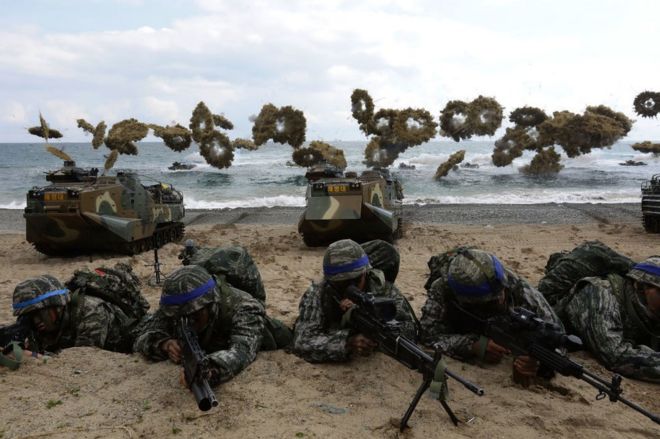
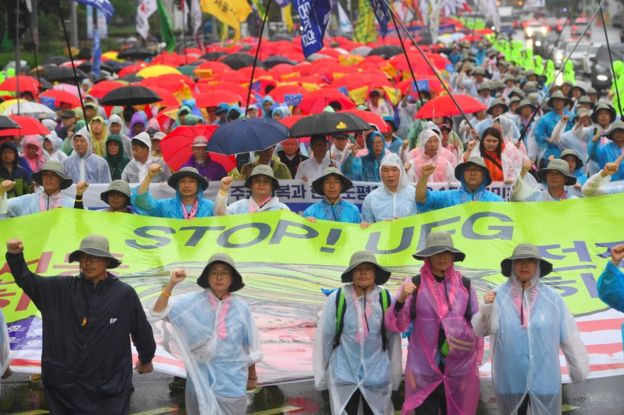
The US and South Korea are conducting annual military drills which consistently infuriate Pyongyang, despite appeals to halt the exercise.
Last week North Korea appeared to back down from a threat to send missiles towards the US Pacific island of Guam, but said it would watch US actions.
It has already condemned these drills as pouring "gasoline on fire".
Washington describes the drills as defensive in nature, but the North sees them as preparation for invasion.
China and Russia earlier proposed a halt on military exercises in exchange for a freeze on missile tests. But Joseph Dunford, chairman of the US Joint Chiefs of Staff, said the military exercises were "not currently on the table as part of the negotiation at any level" and the Ulchi-Freedom Guardian (UFG) exercises are going ahead as planned.
On Sunday an editorial in North Korea's official government newspaper, the Rodong Sinmun said the exercises would worsen the state of the peninsula and warned of an "uncontrollable phase of a nuclear war".
What are these drills?
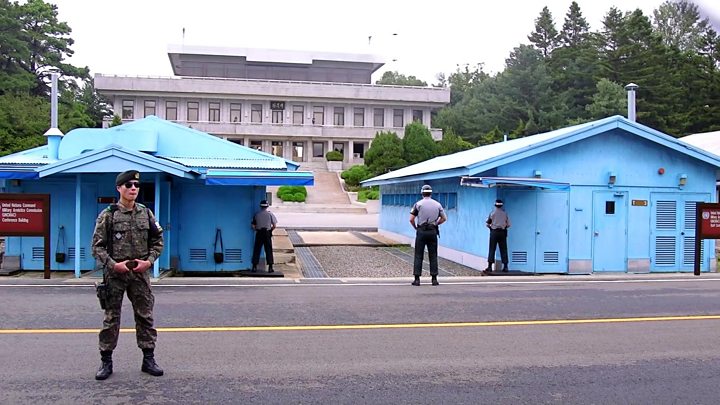 Observers have been watching the north and south watch each other for more than 60 years.
The US and South Korea hold two sets of war games every year, involving a massive number of troops and military hardware.
Foal Eagle/Key Resolve is usually held for several weeks in spring, while Ulchi-Freedom Guardian (UFG) is held in autumn. This year's UFG is set to be held for the next 10 days.
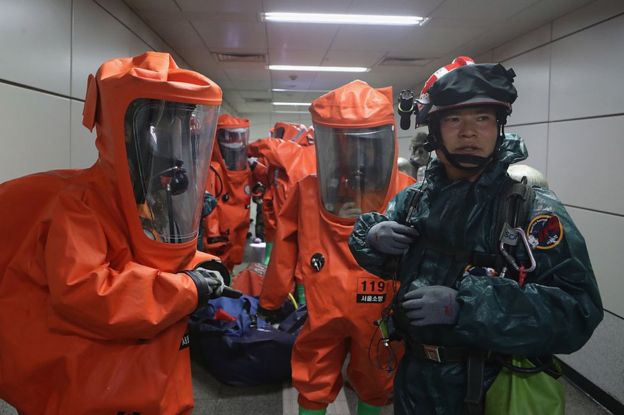
Both involve land, sea and air military drills and computer simulations. Held in South Korea, they have also involved practice drills for terror and chemical attacks in recent years.
South Korea usually deploys about 50,000 troops while the US sends 25,000 to 30,000 soldiers.
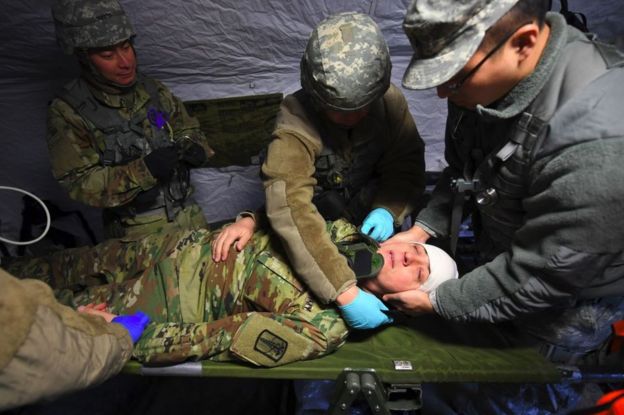
They can also sometimes involve troops from other allies - last year's UFG saw the participation of nine other countries including the UK, Australia, Denmark and the Philippines.
 GETTY IMAGES
The UFG exercise, which dates back to 1976, is named after Ulchi Mundeok, a 7th Century Korean military leader who repelled an invasion from China.
What has been the rhetoric around them?
Both events routinely anger North Korea, which insists that the exercises are rehearsals for an invasion and signs of military aggression towards Pyongyang.
Last week, North Korean state media accused the US of "trying to ratchet up war frenzy while covering up the invasive nature" of the UFG exercise, while in 2010 it said the drills showed the US and South Korea were "harassers of peace and warmongers keen to bring a war to this land".
 AFP/GETTY IMAGES
Earlier this year during Foal Eagle/Key Resolve it warned it would "mercilessly foil the nuclear war racket of the aggressors with its treasured nuclear sword of justice".
But while it has frequently threatened serious retaliation, it usually ends up conducting shows of force, such as firing missiles or moving troops.
The US and South Korea say that the exercises are purely for defence purposes, and based out of a mutual defence agreement they signed in 1953.
Have the drills caused conflict before?
Depending on the political climate, the drills have at times exacerbated relations between the two sides.
The UFG drill in 2015 took place amid high tensions, which bubbled over and resulted in North and South Korea exchanging artillery fire across the border.
Military officials took the unusual step of halting the UFG while emergency talks were held between the North and South. The drill resumed several days later.

No comments:
Post a Comment